
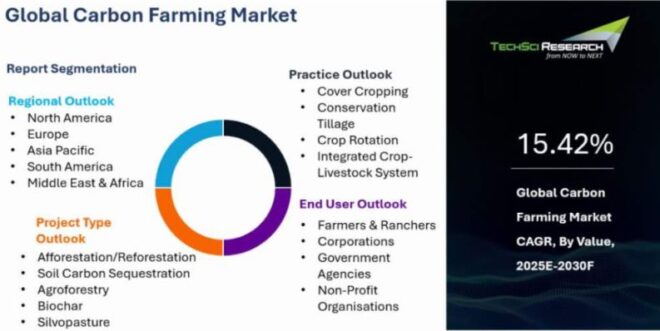
Carbon Farming Market is driven by rising adoption of sustainable agriculture, carbon credit systems, soil health awareness, and government incentives for carbon sequestration, 2026-2030.
According to TechSci Research report, “Carbon Farming Market – Global Industry Size, Share, Trends, Competition Forecast & Opportunities, 2030F”, the global carbon farming market was valued at USD 538.04 Million in 2024 and is projected to reach USD 1,273.72 Million by 2030, growing at a CAGR of 15.42% during the forecast period. Carbon farming is gaining prominence as climate-conscious practices increasingly influence agricultural strategies worldwide. The market encompasses a range of practices designed to enhance soil carbon sequestration, reduce the agricultural carbon footprint, and promote sustainable farming methods.
Market Overview
Carbon farming involves techniques that not only capture carbon from the atmosphere but also improve soil health, productivity, and biodiversity. Key practices include cover cropping, rotational grazing, agroforestry, and integrated crop-livestock systems. With increasing global attention on climate change and environmental sustainability, carbon farming is becoming an essential part of modern agriculture. Governments and organizations worldwide are promoting policies, subsidies, and incentives for farmers adopting carbon sequestration practices, thereby fueling market expansion.
The market is further supported by the growing recognition of the environmental and economic benefits of carbon farming. By improving soil fertility, reducing the need for synthetic fertilizers, and increasing agricultural resilience, carbon farming practices align with both sustainable agriculture goals and broader climate action targets. Additionally, the integration of carbon credit systems allows farmers to monetize their sequestration efforts, creating new revenue streams and incentivizing sustainable practices.
Key Market Drivers
Growing Awareness of Soil Health and Environmental Sustainability
Increasing awareness among farmers and consumers regarding soil degradation, climate change, and environmental sustainability is a primary driver of market growth. Soil carbon sequestration practices improve soil structure, water retention, and nutrient cycling, which enhance overall farm productivity. At the same time, these practices help mitigate greenhouse gas emissions, contributing to global climate targets.
Government Initiatives and Incentives
Governments across the globe are implementing carbon credit systems, subsidies, and climate-resilient farming programs to encourage carbon farming adoption. These initiatives provide financial incentives to farmers for implementing regenerative agricultural techniques, reducing their reliance on synthetic fertilizers, and promoting sustainable land use.
Advancements in Precision Agriculture
The adoption of precision agriculture technologies—such as digital soil sensors, satellite imaging, and IoT-based monitoring systems—is transforming carbon farming. These tools enable farmers to accurately monitor soil carbon levels, moisture content, and crop growth, optimizing carbon sequestration practices. Additionally, they provide reliable data for carbon credit certification, enabling farmers to participate effectively in global carbon markets.
Consumer Demand for Sustainable Products
The increasing preference for organic, sustainably sourced, and eco-friendly products is creating new market opportunities. Producers adopting carbon farming practices can leverage these trends by marketing their products as environmentally responsible, potentially commanding premium prices in both domestic and international markets.
Market Segmentation
The global carbon farming market is segmented by project type, practice, end-user, region, and company.
By Practice: Integrated Crop-Livestock Systems
The integrated crop-livestock system has emerged as the fastest-growing segment. This approach combines crop cultivation and livestock management, creating mutually beneficial synergies. Livestock manure is utilized as natural fertilizer, while crop residues serve as fodder, enhancing nutrient cycling and biodiversity.
Key benefits of this system include:
- Enhanced soil organic matter and fertility
- Increased carbon sequestration and environmental sustainability
- Efficient use of land and resources
- Improved resilience to climate variability
The integration of carbon credit programs further incentivizes farmers, making this system both environmentally and economically advantageous. Its adoption is expected to continue growing as awareness of these benefits expands globally.
Browse over XX market data Figures spread through XX Pages and an in-depth TOC on “Global Carbon Farming Market”
https://www.techsciresearch.com/report/carbon-farming-market/27500.html
Regional Insights: Asia-Pacific
The Asia-Pacific region is the fastest-growing market for carbon farming. This growth is driven by several factors:
- Large agricultural base: Countries like China, India, and Southeast Asian nations have extensive farming sectors that are crucial for both food security and economic stability.
- Climate challenges: Soil degradation, water scarcity, and extreme weather events are prompting the adoption of carbon farming as a solution for sustainable agriculture.
- Government support: Policies promoting carbon credit programs, subsidies, and climate-resilient practices encourage farmers to implement sustainable techniques.
- Awareness and education: Increasing knowledge about environmental impact and sustainable practices among farmers is accelerating adoption.
- Corporate partnerships: Collaborations between agri-businesses and technology providers are driving innovation and efficiency in carbon farming practices.
Asia-Pacific’s rapid adoption of carbon farming reflects the region’s commitment to achieving both economic and environmental goals, positioning it as a key growth market globally.
Emerging Trends
Digital Integration and Monitoring
The integration of IoT, AI, and remote sensing technologies is enabling real-time monitoring of soil health and carbon levels. Farmers can make data-driven decisions that maximize carbon sequestration while maintaining or enhancing crop yields.
Regenerative Agriculture Practices
Regenerative approaches such as cover cropping, rotational grazing, and agroforestry are gaining traction. These methods restore soil organic matter, improve biodiversity, and capture atmospheric carbon effectively.
Carbon Credit and Offset Schemes
The rise of carbon credit trading provides financial incentives for farmers to adopt sustainable practices. Verified carbon sequestration efforts can be monetized, creating additional revenue streams while contributing to corporate sustainability goals.
Consumer Awareness and Market Demand
Growing consumer preference for sustainably sourced and eco-friendly products encourages farmers to adopt carbon farming practices. Products labeled as environmentally responsible are increasingly valued in domestic and international markets.
Market Opportunities
- Expansion of Carbon Credit Markets: Farmers and agricultural enterprises can capitalize on global carbon trading initiatives.
- Technology Partnerships: Collaborations with agri-tech companies can enhance precision, efficiency, and scalability of carbon farming.
- Premium Product Segments: Sustainable produce and eco-labeled products can fetch higher market prices.
- Government Funding and Incentives: Increasing public and private investment in climate-smart agriculture can accelerate market growth.
- Global Climate Action: As countries adopt more ambitious carbon reduction targets, demand for carbon farming practices is expected to surge.
Conclusion
The global carbon farming market is poised for substantial growth from 2024 to 2030, driven by increasing awareness of soil health, environmental sustainability, and climate-smart practices. The adoption of integrated crop-livestock systems, supported by carbon credit programs and technological advancements, is driving both environmental and economic benefits.
Regions such as Asia-Pacific are emerging as major growth hubs due to their large agricultural base, government incentives, and rising awareness of sustainable practices. Innovations in precision agriculture, regenerative techniques, and digital monitoring tools are further enhancing market opportunities.
As global efforts to combat climate change intensify and consumer demand for sustainable products grows, the carbon farming market is expected to expand significantly, offering both environmental benefits and new revenue streams for farmers. Stakeholders, including governments, investors, and agri-tech companies, are increasingly recognizing the strategic value of carbon farming, positioning it as a critical component of the global sustainable agriculture landscape.
Major companies operating in Global Carbon Farming Market are:
Vayda, Inc.
Terramera, Inc.
Indigo Ag Inc.
Soil Capital SPRL
Agoro Carbon Alliance
Carbon Sequestration Inc.
Agreena Copenhagen
HARADA CORPORATION
Continuum Ag
Robofarm GmbH
Download Free Sample Report
https://www.techsciresearch.com/sample-report.aspx?cid=27500
Customers can also request for 10% free customization on this report
“The Global Carbon Farming Market is expanding due to the increasing collaboration between agricultural institutions, NGOs, and governments to promote sustainable farming practices. These partnerships are facilitating the transfer of knowledge, technology, and resources to farmers, especially in developing regions, where access to such tools has been limited. Through training programs and funding, these collaborations are accelerating the adoption of carbon farming techniques, helping farmers transition to practices that enhance carbon sequestration while improving farm productivity.
The collective efforts of these stakeholders are also fostering a supportive policy environment, making carbon farming more accessible and scalable.,” said Mr. Karan Chechi, Research Director of TechSci Research, a research-based management consulting firm.
“Carbon Farming Market – Global Industry Size, Share, Trends, Opportunity, and Forecast, Segmented By Project Type (Afforestation/Reforestation, Soil Carbon Sequestration, Agroforestry, Biochar, Silvopasture), By Practice (Cover Cropping, Conservation Tillage, Crop Rotation, Integrated Crop-Livestock System), By End User (Farmers & Ranchers, Corporations, Government Agencies, Non-Profit Organisations), By Region and Competition, 2020-2030F”, has evaluated the future growth potential of Global Carbon Farming Market and provides statistics & information on market size, structure and future market growth. The report intends to provide cutting-edge market intelligence and help decision makers take sound investment decisions. Besides, the report also identifies and analyzes the emerging trends along with essential drivers, challenges, and opportunities in Global Carbon Farming Market.
Contact
TechSci Research LLC
420 Lexington Avenue, Suite 300,
New York, United States- 10170
Tel: +1-332-258-6602
Email: sales@techsciresearch.com
Website: www.techsciresearch.com