
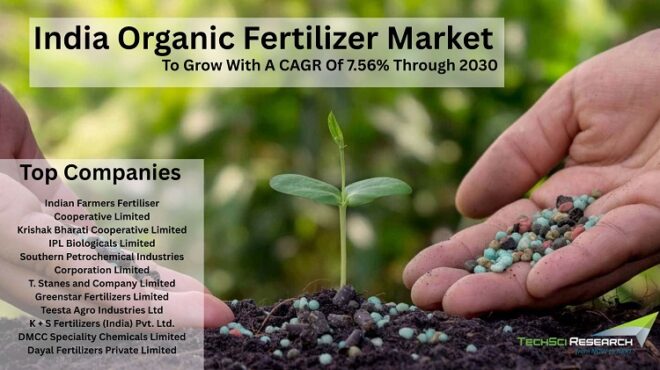
India Organic Fertilizer Market driven by rising organic food demand, sustainable farming awareness, and supportive government initiatives during 2026-2030.
According to the TechSci Research report, “India Organic Fertilizer Market – By Region, Competition, Forecast & Opportunities, 2030F”, the India Organic Fertilizer Market was valued at USD 432.21 million in 2024 and is projected to reach USD 670.85 million by 2030, growing at a CAGR of 7.56% during the forecast period.
The market is witnessing strong growth due to rising consumer demand for organic food, government incentives for sustainable farming, and increasing awareness among farmers about the long-term risks of chemical fertilizer dependence. The transition toward organic inputs is not only an economic decision but also an environmental and cultural shift in Indian agriculture.
Rising Demand for Organic Food and Sustainable Practices
The organic fertilizer market in India has been expanding rapidly as consumers increasingly prefer food that is free from chemical residues. Heightened awareness of health risks associated with synthetic inputs has encouraged farmers to switch to organic fertilizers that support soil health, water conservation, and eco-friendly farming practices.
The willingness of consumers to pay premium prices for certified organic produce has provided a strong financial incentive for farmers. This market-driven demand is being complemented by government support through subsidies, awareness campaigns, and programs that encourage organic inputs over chemical fertilizers. Such initiatives are crucial in building farmer confidence and ensuring long-term sustainability.
Government Support and Policy Initiatives
Government schemes like the Paramparagat Krishi Vikas Yojana (PKVY) and the National Mission on Sustainable Agriculture (NMSA) have played a pivotal role in driving adoption. These programs provide financial assistance, training, and certification support for farmers transitioning to organic farming. Subsidies for compost units, vermicomposting, and biofertilizers have lowered entry barriers and reduced reliance on chemical inputs.
By emphasizing the importance of soil fertility, nutrient recycling, and long-term productivity, the government has positioned organic fertilizers as a cornerstone of sustainable agriculture. This policy environment continues to be a major growth driver for the market.
Role of India’s Agricultural Sector
India’s vast agricultural sector presents immense potential for organic fertilizers. A large portion of farmland still relies on traditional or chemical-intensive methods, which has led to soil degradation, reduced nutrient levels, and declining productivity. Farmers are increasingly aware that continuous chemical use diminishes soil quality, whereas organic fertilizers restore structure, boost microbial activity, and improve yields over time.
The rising cost of synthetic fertilizers is another factor prompting farmers to explore organic alternatives. In many cases, organic fertilizers prove more cost-effective in the long term while contributing to improved sustainability. The rise of contract farming and private sector investments in organic value chains has further accelerated adoption.
Product Segmentation: Dry vs. Liquid Organic Fertilizers
Dry Organic Fertilizers
Dry fertilizers, such as compost, farmyard manure, and plant-based residues, currently dominate the Indian market. Their popularity stems from:
- Slow-release nutrient properties that ensure long-term soil health.
- Ease of storage and transportation, making them suitable for small and large farms alike.
- Low infrastructure requirements for application.
They are widely used across crop categories, from cereals to pulses, and provide consistent soil enrichment.
Liquid Organic Fertilizers
Liquid organic fertilizers, although smaller in market share, are gaining traction, especially in horticulture, floriculture, and high-value crops. Their advantages include:
- Quick nutrient absorption by plants.
- Suitability for precision farming and hydroponics.
- Higher efficiency in targeted applications.
As modern farming practices gain ground, the liquid segment is projected to grow steadily over the forecast period.
Browse over XX market data Figures spread through XX Pages and an in-depth TOC on “India Organic Fertilizer Market”
https://www.techsciresearch.com/report/india-organic-fertilizer-market/9325.html
Regional Insights
North India
North India leads the market due to its large agricultural base, high crop intensity, and government focus on soil health. States like Punjab, Haryana, Uttar Pradesh, and Rajasthan have shown rapid adoption of organic inputs, supported by strong extension services and access to organic fertilizer suppliers.
West India
West India ranks second, with Maharashtra and Gujarat emerging as focal points. The region benefits from diverse cropping systems, ranging from cereals to horticultural crops, and growing consumer demand in urban centers like Mumbai and Ahmedabad. Farmers here are motivated by both health-conscious consumers and government incentives to expand organic production.
South and East India
South India, with states like Karnataka and Tamil Nadu, is also witnessing progress in organic fertilizer adoption, especially in horticulture and plantation crops. East India, on the other hand, faces challenges such as small landholdings, limited farmer awareness, and economic constraints, but ongoing awareness campaigns are expected to improve uptake.
Innovation and Technological Advancements
The market is increasingly shaped by innovation. Manufacturers are focusing on biofertilizers, microbial-based inputs, and crop-specific formulations to enhance efficiency and farmer acceptance. Two major trends include:
- Integration of biofertilizers: Microbial inoculants that promote nitrogen fixation and phosphate solubilization are being blended with organic fertilizers for higher effectiveness.
- Digitalization of access: E-commerce platforms and mobile applications have enabled farmers to access organic fertilizers more easily, compare products, and receive guidance, thus bridging gaps between producers and end-users.
This integration of technology not only improves accessibility but also helps farmers adopt precision farming practices with organic inputs.
Challenges Facing the Market
Despite its growth trajectory, the market faces several challenges:
- Awareness gap: Many small and marginal farmers still perceive organic fertilizers as less effective compared to synthetic alternatives.
- Transition period: The shift from chemical-intensive farming to organic practices often involves an initial adjustment period where yields may temporarily decline.
- Product quality inconsistencies: Lack of standardized regulations has led to variability in fertilizer quality, sometimes undermining farmer confidence.
- Regional accessibility: In certain areas, the supply chain for organic fertilizers remains underdeveloped, limiting availability.
Addressing these barriers is essential for scaling up adoption nationwide.
Segmentation by Origin: The Rise of Plant-Based Fertilizers
Among origins, plant-based organic fertilizers are the fastest-growing segment. Derived from compost, crop residues, and green manure, they offer multiple advantages:
- Affordability and availability, making them attractive to smallholder farmers.
- Improved soil moisture retention and fertility, enhancing yields.
- Cultural acceptance, as plant-based inputs align with traditional Indian farming practices.
By contrast, animal-based fertilizers face cultural and religious barriers, along with higher costs and limited availability. Mineral-based fertilizers, though rich in nutrients, are losing ground due to their environmental impact, reinforcing the shift toward eco-friendly plant-based solutions.
Future Outlook
The India Organic Fertilizer Market is set for sustained growth through 2030. Key factors shaping its future include:
- Continued government subsidies and awareness programs.
- Expanding consumer demand for organic produce.
- Technological advancements in microbial and plant-based formulations.
- Wider use of digital platforms for distribution and farmer education.
As awareness deepens and supply chains strengthen, organic fertilizers are expected to play a transformative role in Indian agriculture, ensuring long-term soil health, environmental sustainability, and farmer prosperity.
Major companies operating in India Organic Fertilizer Market are:
Indian Farmers Fertiliser Cooperative Limited
Krishak Bharati Cooperative Limited
IPL Biologicals Limited
Southern Petrochemical Industries Corporation Limited
T. Stanes and Company Limited
Greenstar Fertilizers Limited
Teesta Agro Industries Ltd
K + S Fertilizers (India) Pvt. Ltd.
DMCC Speciality Chemicals Limited
Dayal Fertilizers Private Limited
Download Free Sample Report
https://www.techsciresearch.com/sample-report.aspx?cid=9325
Customers can also request for 10% free customization on this report
“The future of the India organic fertilizer market looks promising, driven by increasing awareness of sustainable agriculture, government support, and rising consumer demand for organic produce. With concerns over soil degradation and the environmental impact of chemical fertilizers, farmers are gradually shifting towards organic alternatives. Technological advancements, including biofertilizers and microbial solutions, are enhancing efficiency and adoption rates. The expansion of e-commerce and digital platforms is improving market accessibility, further boosting growth.
Additionally, corporate investments and export opportunities for organic products are expected to fuel the sector’s expansion. While challenges like awareness gaps and regulatory standardization remain, the market is set to grow steadily, positioning organic fertilizers as a key component of India’s agricultural transformation.,” said Mr. Karan Chechi, Research Director of TechSci Research, a research-based management consulting firm.
“India Organic Fertilizer Market By Origin (Animal, Plant, Mineral), By Form (Dry and Liquid), By Crop Type (Cereals & Grains, Oilseed & Pulses, Fruits & Vegetables, Others), By Source (Domestic and Import), By Region, Competition, Forecast & Opportunities, 2020-2030F”, has evaluated the future growth potential of India Organic Fertilizer Market and provides statistics & information on market size, structure and future market growth. The report intends to provide cutting-edge market intelligence and help decision makers take sound investment decisions. Besides, the report also identifies and analyzes the emerging trends along with essential drivers, challenges, and opportunities in India Organic Fertilizer Market.
Contact
TechSci Research LLC
420 Lexington Avenue, Suite 300,
New York, United States- 10170
Tel: +1-332-258-6602
Email: sales@techsciresearch.com
Website: www.techsciresearch.com