
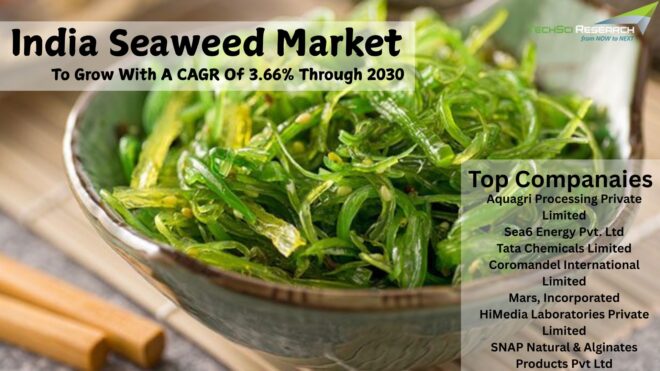
India Seaweed Market driven by rising demand for plant-based, functional foods and strong government initiatives supporting seaweed cultivation during 2026-2030.
According to TechSci Research report, “India Seaweed Market – By Region, Competition, Forecast & Opportunities, 2030”, the India Seaweed Market stood at USD 2.03 billion in 2024 and is expected to reach USD 2.12 billion by 2030, registering a CAGR of 3.66% during the forecast period. The market is witnessing increasing traction across industries such as pharmaceuticals, cosmetics, nutraceuticals, and agriculture, supported by favorable government policies, technological advancements, and growing consumer awareness of natural and sustainable products.
Rising Role of Seaweed in Pharmaceuticals and Cosmetics
The pharmaceutical and cosmetic industries are among the fastest-growing consumers of seaweed in India. The surge is attributed to the bioactive compounds found in seaweed—such as polysaccharides, antioxidants, vitamins, and minerals—that possess therapeutic, nutritional, and skincare benefits.
In the pharmaceutical sector, seaweed-derived ingredients are being integrated into:
- Wound healing agents that accelerate tissue regeneration.
- Anticoagulants effective in treating blood clotting disorders.
- Drug delivery systems designed to enhance bioavailability and reduce side effects.
With the rising incidence of chronic diseases such as diabetes, cardiovascular conditions, and digestive disorders, demand for marine-derived nutraceuticals is increasing. Seaweed-based dietary supplements supporting immune health, gut balance, and metabolic regulation are becoming popular in both preventive and functional medicine.
In the cosmetic and personal care industry, seaweed is valued for its hydrating, detoxifying, and anti-aging properties. Its natural marine collagen content makes it a preferred ingredient for formulations targeting skin rejuvenation and pigmentation control. Products such as seaweed-infused masks, serums, anti-wrinkle creams, and conditioners are witnessing strong growth, especially as Indian consumers increasingly seek organic and clean-label beauty products.
Global cosmetic brands and Indian startups are actively investing in seaweed-based product lines, while advancements in extraction technologies and R&D are enhancing ingredient efficacy, further fueling adoption.
Seaweed as a Climate Solution and Sustainability Driver
Beyond industrial applications, seaweed farming is gaining recognition as a nature-based solution to climate change. Seaweed acts as a natural carbon sink, absorbing significant amounts of CO₂ while also reducing ocean acidification—an issue that threatens marine biodiversity and India’s fisheries sector.
Key sustainability benefits include:
- Carbon sequestration contributing to emission reduction goals.
- Marine ecosystem restoration, improving biodiversity and supporting fisheries.
- Low-resource cultivation, as seaweed requires no freshwater, fertilizers, or pesticides.
The Indian government has identified seaweed farming as part of its Blue Economy Vision, aiming to develop carbon-neutral aquaculture practices while supporting coastal livelihoods. Private players are also exploring carbon credit initiatives, enabling companies to offset emissions by investing in large-scale seaweed farms.
Environmental organizations and impact investors are advocating for seaweed farming integration into carbon offset programs, eco-tourism, and sustainable fisheries management. These efforts position seaweed not only as a commercial commodity but also as a critical enabler of environmental resilience and coastal community development.
Market Segmentation Insights
The India Seaweed Market is segmented into type, method of cultivation, application, form, regional distribution, and company.
1. By Type: Brown Seaweed Leads Growth
Brown seaweed—including varieties such as Sargassum, Laminaria, and Turbinaria—is emerging as the fastest-growing segment. Its rising demand stems from its diverse applications:
- Food industry: Brown seaweed is rich in alginates, fucoidans, and iodine, making it essential in the production of thickeners, stabilizers, and emulsifiers. These additives are widely used in dairy, beverages, and confectionery—sectors witnessing robust expansion in India’s food processing industry.
- Agriculture: Brown seaweed is increasingly adopted in organic fertilizers and animal feed supplements. Its bioactive components enhance soil fertility, improve crop resilience, and boost livestock nutrition. The rising focus on sustainable farming practices is accelerating demand.
- Health and wellness: Known for its anti-inflammatory and antioxidant properties, brown seaweed is being incorporated into dietary supplements and functional foods.
Government incentives for aquaculture and rising consumer demand for natural, eco-friendly products further support the growth of this segment, making brown seaweed a cornerstone of India’s seaweed industry.
Browse over XX market data Figures spread through XX Pages and an in-depth TOC on “India Seaweed Market”
https://www.techsciresearch.com/report/india-seaweed-market/14366.html
2. By Region: South and West India Drive Market Expansion
While South India continues to dominate seaweed cultivation due to its long coastline and traditional practices, West India is rapidly emerging as a growth engine for the sector.
- Gujarat has become a focal point of West India’s seaweed industry. Its coastline along the Arabian Sea provides ideal conditions—shallow waters, stable salinity, and favorable temperatures—for cultivating high-value seaweed species such as Gracilaria and Sargassum.
- The Gujarat government is actively supporting the sector through subsidies, training programs, and collaborations with marine research institutes. Pilot projects and community-driven initiatives are further boosting production.
- The region is also witnessing growing private-sector participation and investments in processing infrastructure, enhancing domestic supply and export potential.
With expanding industrial demand, supportive policies, and strong research collaborations, West India is poised to strengthen its role in the national seaweed market.
Government Policies and Industry Collaboration
Government initiatives, such as the Pradhan Mantri Matsya Sampada Yojana (PMMSY), are prioritizing the development of seaweed farming and processing industries. By providing subsidies, technical support, and R&D funding, policymakers aim to position India as a global hub for sustainable seaweed cultivation.
Collaboration between government agencies, private enterprises, and academic institutions is also advancing innovations in cultivation techniques, processing technologies, and product applications. These partnerships are essential for ensuring both economic growth and environmental sustainability in the sector.
Future Outlook
The India Seaweed Market is expected to maintain steady growth through 2030, fueled by:
- Expanding pharmaceutical, nutraceutical, and cosmetic applications.
- Rising consumer demand for plant-based, functional, and organic products.
- Government initiatives promoting aquaculture and coastal livelihood development.
- Sustainability-driven adoption of seaweed farming as a climate solution.
Brown seaweed is set to remain the fastest-growing type, while regions such as Gujarat will continue strengthening India’s production base. Investments in advanced extraction technologies and integrated value chains will further enhance market competitiveness.
Overall, India’s seaweed industry is transitioning from a niche sector to a strategic growth industry with wide-ranging economic, environmental, and social benefits.
Major companies operating in India Seaweed Market are:
Aquagri Processing Private Limited
Sea6 Energy Pvt. Ltd
Tata Chemicals Limited
Coromandel International Limited
Mars, Incorporated
HiMedia Laboratories Private Limited
SNAP Natural & Alginates Products Pvt Ltd
Download Free Sample Report
https://www.techsciresearch.com/sample-report.aspx?cid=14366
Customers can also request for 10% free customization on this report
“The global transition toward renewable energy sources has heightened interest in seaweed-based biofuels, positioning seaweed as a promising feedstock for bioethanol and biodiesel production in India. Given the country’s commitment to reducing fossil fuel dependency and achieving net-zero emissions, alternative bioenergy solutions derived from marine biomass are gaining traction. Seaweed offers distinct advantages over conventional biofuel feedstocks such as sugarcane, corn, and palm oil, as it does not compete with food crops for arable land and requires minimal freshwater or fertilizers for cultivation. Several Indian research institutions and bioenergy startups are exploring efficient seaweed fermentation and enzymatic conversion technologies to enhance biofuel yield and scalability.
Moreover, collaborations between energy companies and marine biotech firms are facilitating the commercialization of algae-based biodiesel production, further driving investments in seaweed cultivation. Government support in the form of renewable energy subsidies, tax incentives, and R&D funding is also accelerating innovation in this space.
The National Bio-Energy Mission is encouraging alternative energy solutions, and seaweed-based biofuels are expected to play a key role in India’s sustainable energy transition. With ongoing advancements in bioconversion technologies and commercialization of algae-based energy solutions, the integration of seaweed-derived biofuels into India’s renewable energy mix is set to drive significant growth in the India Seaweed Market, while simultaneously addressing energy security and climate change challenges.,” said Mr. Karan Chechi, Research Director of TechSci Research, a research-based management consulting firm.
“India Seaweed Market By Type (Brown, Red, Green), By Method of Cultivation (Single Rope Floating Raft Method, Fixed Bottom Long Thread Method, Integrated Multi-Trophic Aquaculture), By Form (Liquid, Dry), By Application (Human Consumption, Non-Human Consumption), By Region, Competition, Forecast & Opportunities, 2020-2030F”, has evaluated the future growth potential of India Seaweed Market and provides statistics & information on market size, structure and future market growth. The report intends to provide cutting-edge market intelligence and help decision makers take sound investment decisions. Besides, the report also identifies and analyzes the emerging trends along with essential drivers, challenges, and opportunities in India Seaweed Market.
Contact
TechSci Research LLC
420 Lexington Avenue, Suite 300,
New York, United States- 10170
Tel: +1-332-258-6602
Email: sales@techsciresearch.com
Website: www.techsciresearch.com