
India Vertical Farming Market growth is fueled by limited arable land, water scarcity, and rising demand for sustainable agriculture during 2026-2030.
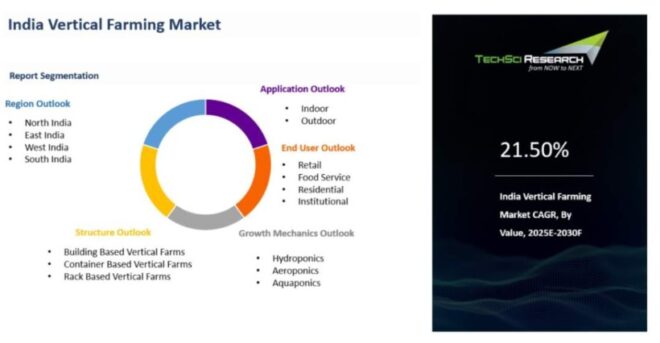
According to TechSci Research report, “India Vertical Farming Market – By Region, Competition Forecast & Opportunities, 2030”, the India Vertical Farming Market was valued at USD 62.21 million in 2024 and is projected to grow at a CAGR of 21.50% between 2026 and 2030. The market is expanding rapidly as India addresses critical agricultural challenges, including limited arable land, water scarcity, and rising demand for sustainable food production.
Vertical farming, which involves cultivating crops in vertically stacked layers or controlled indoor environments, is increasingly recognized as a solution to these challenges. Leveraging hydroponics, aeroponics, and advanced automation, vertical farming maximizes productivity in limited spaces while minimizing resource usage.
Market Drivers
Addressing Land and Water Scarcity
India faces mounting pressure on its agricultural resources due to rapid population growth, industrialization, and urbanization. With limited arable land and declining groundwater availability, traditional farming methods often fall short of meeting food demand. Vertical farming offers a sustainable alternative, using up to 95% less water compared to conventional farming and producing crops in controlled environments independent of seasonal constraints.
Rising Demand for Organic and Nutritious Food
Consumer preferences are shifting toward fresh, organic, and pesticide-free food. Urban populations, in particular, seek nutritious produce that is locally grown and safe for consumption. Vertical farming directly caters to this demand by ensuring year-round production of high-quality crops such as leafy greens, herbs, and microgreens.
Government Initiatives and Policy Support
The Government of India is actively promoting agri-tech innovations. Initiatives such as subsidies for modern farming techniques, support for hydroponic startups, and policy incentives for sustainable agriculture are accelerating the adoption of vertical farming. This government backing creates a favorable environment for both startups and large-scale commercial projects.
Technological Advancements
Advances in LED lighting, climate control systems, and automation are enhancing the scalability and cost-effectiveness of vertical farming. Artificial intelligence (AI) and Internet of Things (IoT) solutions are increasingly integrated into farm operations, enabling real-time monitoring, predictive analytics, and improved crop yields. These technologies not only improve operational efficiency but also reduce risks associated with pests and weather fluctuations.
Market Opportunities
Urbanization and Space-Efficient Farming
India is witnessing unprecedented urbanization, with more than 35% of its population living in cities. Vertical farming is ideally suited for urban centers, where space is constrained, and demand for fresh produce is high. By utilizing rooftops, warehouses, and abandoned buildings, vertical farming allows cities to localize food production, reducing transportation costs and carbon emissions.
Private Investments and Startup Ecosystem
Private investors and venture capital firms are showing strong interest in the vertical farming sector. A growing number of startups are offering cost-effective hydroponic kits, indoor farm solutions, and modular systems tailored to Indian conditions. This ecosystem of innovation and entrepreneurship is accelerating market growth and driving down costs.
Potential for Export-Oriented Growth
Beyond catering to domestic demand, India’s vertical farming industry has the potential to serve export markets. With the global rise in demand for organic produce, Indian vertical farming enterprises can target premium markets in the Middle East, Europe, and North America, where consumers pay a premium for sustainable and pesticide-free crops.
Market Segmentation
By Application: Indoor Farming Leads Growth
The indoor vertical farming segment is emerging as the fastest-growing category. Indoor farms offer controlled conditions for growing crops regardless of weather or external environment, making them especially suitable for densely populated urban areas. Crops such as spinach, lettuce, basil, and microgreens thrive in these settings.
Key advantages include:
- Year-round production independent of climate.
- Minimal use of pesticides and fertilizers.
- Integration of hydroponics and aeroponics for resource efficiency.
Additionally, the adoption of LED grow lights, climate control, and automation systems enhances crop productivity and reduces operating costs. With health-conscious lifestyles on the rise, indoor vertical farming is set to remain a dominant driver of India’s market expansion.
Browse over XX market data Figures spread through XX Pages and an in-depth TOC on “India Vertical Farming Market”
https://www.techsciresearch.com/report/india-vertical-farming-market/15429.html
By Region: West India Emerging as a Growth Hub
West India is positioning itself as a leader in vertical farming adoption, driven by its urbanization, infrastructure, and consumer demand for fresh produce.
- Maharashtra, with cities like Mumbai and Pune, is at the forefront due to high demand for organic food and limited availability of farmland.
- Gujarat and Rajasthan are adopting vertical farming to address water scarcity while capitalizing on favorable government policies for agri-tech adoption.
- Urban centers in these states are leveraging vertical farming to reduce reliance on distant agricultural supply chains.
The region’s commitment to sustainability and innovation, combined with investments in hydroponic and automation technologies, positions West India as a critical growth hub.
Emerging Trends
Floating and Modular Farms
To further address space limitations, floating farms and modular vertical farm units are gaining attention. These innovative models expand the possibilities for deployment in both urban and semi-urban regions.
Integration of Renewable Energy
Sustainability is becoming a cornerstone of vertical farming projects. The integration of solar panels, wind energy, and energy-efficient climate systems helps reduce operational costs while ensuring environmental sustainability.
Smart Farming and Data Analytics
IoT-enabled sensors and AI-driven systems are transforming vertical farming into data-driven agriculture. Real-time insights into soil nutrients, water levels, and plant health are enabling predictive maintenance and higher yields with lower resource use.
Challenges
While the outlook is promising, challenges remain:
- High initial investment costs for infrastructure and technology.
- Energy dependency, as climate control and LED lighting require significant electricity.
- Limited awareness and technical expertise among traditional farmers.
Addressing these issues through policy incentives, training programs, and energy-efficient solutions will be critical to scaling the industry.
Conclusion
The India Vertical Farming Market is on a strong growth trajectory, driven by the convergence of urbanization, sustainability, and technology adoption. With government support, rising consumer awareness, and a thriving startup ecosystem, vertical farming is poised to revolutionize India’s agricultural landscape.
As the country seeks to ensure food security for its growing population, vertical farming offers a scalable, sustainable, and innovative solution. By enabling year-round production, minimizing resource consumption, and meeting the demand for organic food, vertical farming will play an increasingly vital role in India’s transition to modern, sustainable agriculture.
Major companies operating in India Vertical Farming Market are:
Sky Green Pvt. Ltd.
Edible Routes Pvt. Ltd.
Future Farms Pvt. Ltd.
Letcetra Agritech Pvt. Ltd.
Living Greens Organics
Download Free Sample Report
https://www.techsciresearch.com/sample-report.aspx?cid=15429
Customers can also request for 10% free customization on this report
“The India vertical farming market is expected to witness substantial growth during the forecast period due to the increasing demand for sustainable and efficient agricultural practices, especially in urban areas. The growing need for fresh, high-quality produce, coupled with the limitations of traditional farming methods in urban settings, is driving the adoption of vertical farming. Innovations in farming technologies, such as hydroponics, aeroponics, and automation, are expected to enhance productivity, reduce resource consumption, and enable year-round crop production.
The combination of technological advancements, environmental concerns, and the growing consumer demand for fresh, sustainable food sources is expected to drive the India vertical farming market forward,” said Mr. Karan Chechi, Research Director of TechSci Research, a research-focused management consulting firm.
“India Vertical Farming Market By Structure (Building Based Vertical Farms, Container Based Vertical Farms, and Rack Based Vertical Farms), By Growth Mechanics (Hydroponics, Aeroponics, and Aquaponics) By Application Type (Indoor and Outdoor), By End User (Retail, Food Service, Residential, and Institutional), By Region, Competition, Forecast & Opportunities, 2020-2030F”, has evaluated the future growth potential of India Vertical Farming Market and provides statistics & information on market size, structure and future market growth. The report intends to provide cutting-edge market intelligence and help decision makers take sound investment decisions. Besides, the report also identifies and analyzes the emerging trends along with essential drivers, challenges, and opportunities in India Vertical Farming Market.
Contact
TechSci Research LLC
420 Lexington Avenue, Suite 300,
New York, United States- 10170
Tel: +1-332-258-6602
Email: sales@techsciresearch.com
Website: www.techsciresearch.com