
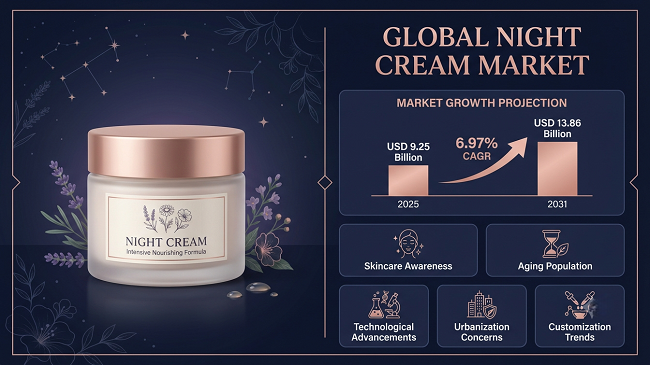
Anti-aging formulations and Asia Pacific demand lead growth as consumers invest in overnight skin repair.The Global Night Cream Market’s growth is driven due to a combination of factors such as increasing skincare awareness, an aging population, technological advancements, urbanization-related concerns, and customization trends.
According to a report by TechSci Research, the Global Night Cream Market was valued at USD 9.25 billion in 2025 and is projected to reach USD 13.86 billion by 2031, growing at a CAGR of 6.97% over 2026-2031. The report, “Night Cream Market – Global Industry Size, Share, Trends, Opportunity, and Forecast 2021-2031F,” covers product type, price range, sales channel and region.
Skincare Moves Beyond the Daytime Routine
Night creams are formulated with concentrated active ingredients to support the skin’s natural repair processes during sleep. TechSci Research attributes the market’s expansion to growing awareness of skin health, an aging global population, and rising disposable incomes. Together these allow consumers to invest in complete skincare regimens rather than basic daytime protection.
Sector data points the same way. Cosmetics Europe reports that skin care remained the largest category in the European cosmetics market in 2024, with retail sales of €30.1 billion.
Key Growth Drivers
The report identifies the aging population and anti-aging concerns as the primary growth driver. As consumers grow older, they look for nighttime products that offer clinically supported results beyond hydration. Ingredients such as retinol and thiamidol, which target wrinkles and pigmentation, are in particular demand.
Corporate performance reflects this shift. Beiersdorf’s Derma business unit, which includes Eucerin and Aquaphor, recorded organic sales growth of 10.6% in 2024, according to the company’s Annual Report.
A second driver is greater awareness of nighttime cellular repair. Educational content on digital platforms has widened the consumer base, bringing younger shoppers into multi-step evening routines. Forbes reported in December 2025 that Gen Alpha consumers contributed USD 2.5 billion to skincare spending in the previous year.
Browse over XX market data Figures spread through XX Pages and an in-depth TOC on the “Global Night Cream Market.”
https://www.techsciresearch.com/sample-report.aspx?cid=3634
Anti-Aging Cream the Fastest-Growing Segment
By product type, the market is divided into moisturizing, anti-aging and skin whitening creams, among others. Anti-aging cream is the fastest-growing segment, supported by a rising global median age and growing demand for ways to address fine lines and loss of elasticity without invasive procedures. Products promising visible rejuvenation continue to gain ground over conventional night creams.
Asia Pacific Holds the Largest Market Share
Asia Pacific is the largest regional market. Skincare and anti-aging maintenance have deep cultural roots in the region, and multi-step routines focused on overnight repair are standard in South Korea, Japan and China. Rising incomes in developing economies are supporting purchases of premium personal care products, while the presence of major cosmetic manufacturers ensures wide availability of products tailored to regional skin needs.
Emerging Trends: Biotech Actives and Sustainable Packaging
The report highlights two trends reshaping the industry. The first is the use of biotech-derived and lab-grown actives. Manufacturers are using fermentation and cellular agriculture to produce bio-identical ingredients such as squalane and collagen. These offer consistent quality and reduce the pressure on rare botanical resources. Givaudan reported 5.7% like-for-like sales growth in its Fragrance Ingredients and Active Beauty division in the first half of 2025.
The second trend is refillable and sustainable packaging. Night creams have traditionally been sold in heavy, hard-to-recycle jars, and brands are now moving toward durable outer casings with replaceable pods. A 2025 Shorr Packaging Corp consumer report found that 90% of consumers are more likely to buy from brands with eco-friendly packaging.
Economic Pressures Remain a Challenge
TechSci Research cautions that economic instability and inflation may constrain growth. Because night creams are often seen as premium add-ons rather than essentials, shoppers may trade down to basic moisturizers during downturns. Manufacturers also face pressure from rising raw material costs, which are hard to pass on to price-sensitive buyers. The British Beauty Council forecast only 3% growth for the personal care industry in 2025, citing weaker household spending.
Recent Product Launches
Leading brands continue to invest in innovation:
- Vichy Laboratoires (August 2025) launched the Mineral 89 Moisture Recovery Night Cream, combining melatonin, hyaluronic acid and volcanic water.
- Nivea (February 2025) introduced the Luminous Even Glow range, including a night cream built on patented Thiamidol technology for dark spots and hyperpigmentation.
- Estée Lauder (April 2024) unveiled the Revitalizing Supreme+ Night Power Bounce Crème, featuring its CollaNight-8 technology.
- Clarins (March 2024) launched the Multi-Active Night Cream, combining niacinamide and organic sea holly extract to strengthen the skin barrier.
Competitive Landscape
Key players profiled in the report include Beiersdorf AG, Estée Lauder Companies Inc., L’Oréal S.A., Shiseido Co. Ltd., Solstice Holding Inc., Clinique Laboratories LLC, Procter & Gamble Co., Avon Products Inc., Himalaya Global Holdings Ltd., and Unilever PLC.
Download Free Sample Report
https://www.techsciresearch.com/sample-report.aspx?cid=3634
Customers can also request for 10% free customization on this report.
The report also segments the market by price range (mass and premium) and sales channel (supermarkets/hypermarkets, multi-branded stores, pharmacies and drug stores, online, and others). It provides analysis across North America, Europe, Asia Pacific, South America, and the Middle East & Africa.
“Night Cream Market – Global Industry Size, Share, Trends, Opportunity, and Forecast Segmented By Product Type (Moisturizing Cream, Anti-Aging Cream, Skin Whitening Cream, and Others), By Price Range (Mass and Premium), By Sales Channel (Supermarkets/Hypermarkets, Multi-Branded Stores, Pharmacy & Drug Stores, Online, and Others (Exclusive Stores, etc.), By Region, By Competition Forecast & Opportunities 2021-2031F, has evaluated the future growth potential of the night cream market globally and provides statistics and information on market structure, size, share, and future growth. The report provides cutting-edge market intelligence and helps decision-makers to make sound investment decisions. Besides, the report also identifies the emerging trends along with essential drivers, challenges, and opportunities present in the market of night cream globally.
Contact
TechSci Research LLC
708 Third Avenue,
Manhattan, NY,
New York – 10017
Tel: +1-646-360-1656
Email: sales@techsciresearch.com
Website: https://www.techsciresearch.com