
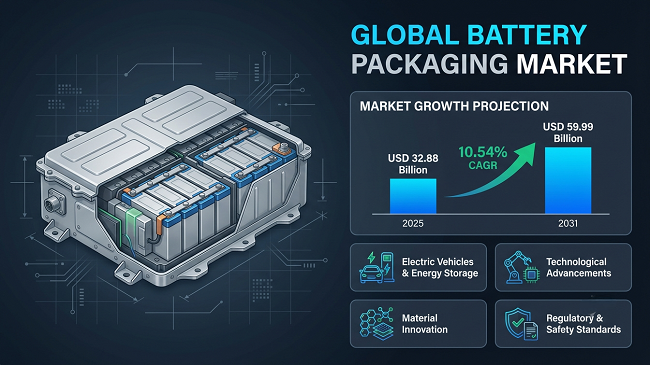
Electric vehicle growth and grid-scale energy storage drive demand for protective, lightweight and sustainable packaging. The Global Battery Packaging Market’s growth is driven by the rapid growth of electric vehicles and energy storage systems, technological advancements, and material innovation, and stringent regulatory and safety standards.
According to a report by TechSci Research, the Global Battery Packaging Market was valued at USD 32.88 billion in 2025 and is projected to reach USD 59.99 billion by 2031, growing at a CAGR of 10.54% over 2026-2031. The report, “Battery Packaging Market – Global Industry Size, Share, Trends, Opportunity, and Forecast, 2021-2031F,” segments the market by type of casing, type of packaging, material, level of packaging and region.
What Battery Packaging Covers
Battery packaging includes the external casings, thermal management layers and structural components that house energy storage cells. These components provide electrical insulation and protection against physical impact. TechSci Research says the sector is driven by rising electric vehicle (EV) production and the growing deployment of renewable energy storage systems, both of which need robust containment solutions.
Electric Vehicles Are the Primary Catalyst
The report names rapid EV industry expansion as the main growth driver. Automakers are scaling production to meet emission targets, which increases demand for casings and thermal regulation systems that can contain thermal runaway and keep battery packs safe. The European Automobile Manufacturers’ Association reports that battery-electric vehicles held a 13.6% share of the European market in 2024. The International Energy Agency’s Global EV Outlook 2024 notes that electric car sales reached nearly 14 million in 2023, increasing consumption of specialized aluminum and composite housings.
This growth is pushing suppliers to focus on lightweighting and structural integrity. Heavier battery packs still require rigorous impact protection.
Browse over XX market data Figures spread through XX Pages and an in-depth TOC on the “Global Battery Packaging Market.”
https://www.techsciresearch.com/sample-report.aspx?cid=3640
Grid-Scale Storage Adds a Second Demand Engine
Utility-scale battery installations are a second source of growth. Utilities are building large battery farms to stabilize the integration of renewable power, which requires modular, weather-resistant packaging that can withstand outdoor exposure. The U.S. Energy Information Administration reported that developers planned to add 14.3 GW of U.S. battery storage capacity in 2024. The IEA also found that global battery demand rose by more than 40% in the preceding year, pointing to sustained demand for varied packaging formats.
Corrugated Packaging the Fastest-Growing Segment
By type of packaging, the market is split into corrugated, blister and other formats. Corrugated is the fastest-growing segment. Its fluted structure absorbs shock and protects sensitive components in transit. It is also lightweight and cost-effective, which helps logistics efficiency, and it supports compliance with United Nations transport rules for dangerous goods, which cover shipments of lithium-ion batteries.
Asia Pacific Leads the Global Market
Asia Pacific is the largest regional market, reflecting high EV and consumer electronics manufacturing volumes in China, Japan and South Korea. The concentration of major battery producers creates steady demand for packaging that keeps hazardous goods safe in transit. Support from authorities, including China’s Ministry of Industry and Information Technology for electric mobility, has also lifted battery production rates in the region.
Key Trends: Structural Designs and Sustainable Materials
The report highlights two trends reshaping the industry. The first is the adoption of Cell-to-Pack (CTP) and Cell-to-Chassis designs. These designs remove intermediate module components to improve space efficiency and cut weight, allowing higher energy density in the same footprint. CATL reported in its 2023 Annual Report that its module-free Qilin battery had reached mass production, and that the company held a 36.8% share of the global EV battery market.
The second trend is the shift toward recycled and bio-based packaging materials. Suppliers are replacing virgin aluminum and high-grade plastics with recovered alloys and renewable composites, partly to reduce Scope 3 emissions and secure critical mineral supply chains. In September 2024, the U.S. Department of Energy announced awards to 25 projects, including efforts to expand domestic processing of recycled battery materials.
Raw Material Volatility Remains a Challenge
TechSci Research cautions that volatile raw material prices and supply chain instability could slow growth. Manufacturers depend on steady access to aluminum and high-performance polymers, and price swings complicate planning and can strain relationships with automotive customers. The Aluminum Association reported that aluminum imports into North America fell 14% year-to-date in 2024. Stricter international rules on recyclability and lifecycle traceability add further cost and technical burdens for suppliers.
Recent Developments
- Energizer Holdings (January 2025) launched plastic-free, fully recyclable paper-based packaging for its household batteries, replacing traditional plastic blister packs.
- Constellium (September 2024) reported results from its £15 million ALIVE project, showing structural aluminium battery enclosures with weight savings of 12% to 35%.
- Webasto (May 2024) expanded its battery pack plant in Dangjin, South Korea, adding 100,000 packs of annual capacity.
- SGL Carbon (January 2024) partnered with E-Works Mobility to supply glass fiber-reinforced plastic battery cases for the HEERO electric transporter.
Download Free Sample Report
https://www.techsciresearch.com/sample-report.aspx?cid=3640
Customers can also request for 10% free customization on this report.
Competitive Landscape
Key companies profiled in the report include Söhner Kunststofftechnik GmbH, Trinseo, GWP Protective, EaglePicher Technologies, CHEP, Wellplast AB, Targray, NEFAB Group, CL Smith and Cadenza Innovation Inc.
The report also covers cylindrical, prismatic and pouch casings, metal, plastic and cardboard materials, and cell and pack packaging versus transportation packaging. Regional analysis spans North America, Europe, Asia Pacific, South America, and the Middle East & Africa.
“Global Battery Packaging Market – Global Industry Size, Share, Trends, Opportunity, and Forecast, Segmented By Type of Casing (Cylindrical, Prismatic, and Pouch), By Type of Packaging (Corrugated, Blister, and Others), By Material (Metals, Plastics, Cardboard, and Others), By Level of Packaging (Cell & Pack Packaging and Transportation Packaging), By Region, By Competition Forecast & Opportunities, 2021-2031F”, has evaluated the future growth potential of the battery packaging market globally and provides statistics and information on market structure, size, share, and future growth. The report provides cutting-edge market intelligence and helps decision-makers to make sound investment decisions. Besides, the report also identifies the emerging trends along with essential drivers, challenges, and opportunities present in the market of battery packaging globally.
Contact
TechSci Research LLC
708 Third Avenue,
Manhattan, NY,
New York – 10017
Tel: +1-646-360-1656
Email: sales@techsciresearch.com
Website: https://www.techsciresearch.com