
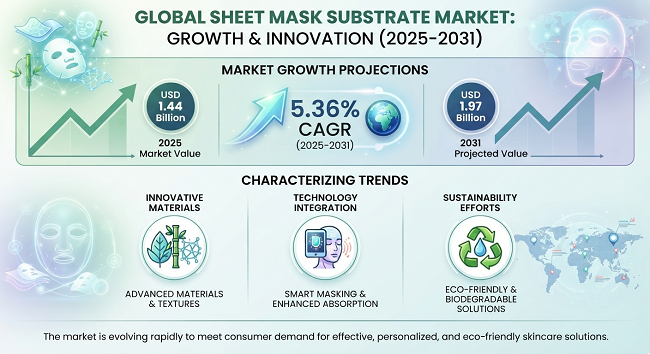
Sustainable materials, K-beauty influence and functional fabric innovation are reshaping the carrier fabrics behind the world’s sheet masks. The Global Sheet Mask Substrate Market is characterized by innovative materials, technology integration, and sustainability efforts, as brands cater to consumer demand for effective, personalized, and eco-friendly skincare solutions.
The global sheet mask substrate market was valued at USD 1.44 billion in 2025. According to a report by TechSci Research, it is projected to reach USD 1.97 billion by 2031, growing at a compound annual growth rate (CAGR) of 5.36% from 2026 to 2031. The report, “Sheet Mask Substrate Market – Industry Size, Share, Trends, Opportunity, and Forecast 2021-2031F,” analyzes the market by substrate type, gender, distribution channel and region.
Sheet mask substrates are the carrier fabrics that deliver active skincare ingredients to the skin. They include nonwoven, cotton, hydrogel and bio-cellulose materials. The report says that growth rests on a lasting consumer shift toward convenient at-home skincare and rising industrial demand for sustainable, biodegradable fibers. TechSci describes these drivers as a stable foundation, distinct from short-lived cosmetic trends or viral product fads.
Sustainability Is Reshaping Materials
The shift toward biodegradable and eco-friendly materials is the most significant driver. Under growing environmental scrutiny, brands are moving away from synthetic polymers toward compostable fibers such as lyocell, bamboo and bio-cellulose. Regulatory frameworks such as the EU Single-Use Plastics Directive add to the pressure. This is a structural change, because nonwoven suppliers must retool production lines for natural fibers that keep wet strength and serum retention. EDANA reported that 2024 deliveries of nonwovens for the personal care wipes segment rose 4.8%, which points to demand for environmentally responsible wet-application substrates.
The popularity of Korean beauty regimens is also driving volume and innovation. Daily sheet mask use has moved from an occasional indulgence to a routine habit, which requires large volumes of high-performance carriers such as hydrogel and ultra-thin cotton. South Korea’s Ministry of Food and Drug Safety reported record cosmetic exports of USD 10.2 billion in 2024. Korea Customs Service data show that skincare products accounted for USD 7.67 billion of that total.
Waste Scrutiny Complicates Compliance
Environmental scrutiny of single-use synthetic waste is the main barrier to growth. Stricter disposal mandates force companies to divert resources from innovation to compliance, and producers that rely on conventional synthetic fibers risk penalties or market exclusion if they miss emerging standards. The scale of the industry adds to this scrutiny. The European Disposables and Nonwovens Association reported that nonwovens production in Greater Europe reached 2,976,400 tonnes in 2024. The report also notes strong raw material capacity: China’s spunlaced nonwovens output reached 1.67 million tons in 2024, up 8.1% year on year, according to the China Nonwovens and Industrial Textiles Association.
Browse over XX market data Figures spread through XX Pages and an in-depth TOC on the “Global Sheet Mask Substrate Market.”
https://www.techsciresearch.com/sample-report.aspx?cid=3487
Key Trends: Functional Substrates and Dry Formats
Manufacturers are embedding bioactive ingredients such as charcoal, algae and Vitamin C directly into the fiber structure during extrusion. This turns the substrate from a passive vessel into an active part of the treatment, allowing controlled release and better stability for volatile ingredients. Ahlstrom reported a record comparable EBITDA margin of 15.2% for 2024, which reflects the premium positioning of functionalized fiber technologies over commodity nonwovens.
Dry and water-activated sheet mask formats are also gaining traction. These masks are supplied dry, with dormant actives that activate on hydration. This keeps unstable ingredients such as Vitamin C potent, removes the need for heavy preservatives and lowers shipping weight and spoilage risk. The Association of the Nonwoven Fabrics Industry (INDA) reported that North American nonwovens capacity reached 5.730 million tonnes in 2024, giving the region a manufacturing base for the airlaid and composite fabrics these formats need.
Segment and Regional Highlights
Nonwoven is the fastest-growing substrate segment, owing to its balance of affordability and performance. Its high absorbency supports effective serum delivery, its porous structure improves breathability and comfort, and its lower production cost makes it the first choice for mass-market skincare brands.
Asia Pacific is the largest regional market, driven by a strong skincare culture and the reach of K-beauty and J-beauty trends. The region also has a robust manufacturing base and abundant raw materials. Safety protocols set by bodies such as China’s National Medical Products Administration support product reliability and the region’s lead.
Recent Developments
- November 2024: Lenzing Group and Graminton Enterprise announced a collaboration on responsible sheet masks using Veocel lyocell fibers.
- June 2024: Asahi Kasei presented Bemliese, a biodegradable continuous-filament cellulosic nonwoven made from upcycled cotton linter, at the World of Wipes International Conference.
- March 2024: Sunrider International launched its Kandesn Pure Bio Cellulose Mask, made from fermented coconut extract.
- January 2024: Researchers published a study on a dry-packaged hydrating mask using a water-repelling plant-based polylactic acid (PLA) sheet, which removes the need for preservatives and plastic liners.
Competitive Landscape
The report profiles key players including Alliqua BioMedical, Inc., Shanghai GUI Zhi International Trading Co., Ltd., TAIKI GROUP, Bel Mondo Beauty, Biocrown Biotechnology Co. Ltd., Denex International, Fitesa S.A., Intracosmed AG, KATECHO, INC. and Nox Bellow Cosmetics. It segments the market by substrate type (nonwoven, cotton, hydrogel and bio-cellulose), gender (male and female), distribution channel (online and offline) and region.
Download Free Sample Report
https://www.techsciresearch.com/sample-report.aspx?cid=3487
Customers can also request for 10% free customization on this report.
“The Global Sheet Mask Substrate Market stands at the crossroads of innovation, convenience, and sustainability. The market’s growth is driven by consumer demand for effective skincare solutions, advancements in substrate materials and technologies, and the rise of personalized beauty routines. As the skincare landscape continues to evolve, manufacturers and brands that can navigate challenges and deliver tailored, sustainable, and high-performance sheet mask substrates are poised to lead the market’s expansion, meeting the ever-changing needs of consumers seeking optimal skincare experiences.” said Mr. Karan Chechi, Research Director with TechSci Research, a research-based global management consulting firm.
“Global Sheet Mask Substrate Market– Industry Size, Share, Trends, Opportunity, and Forecast, Segmented By Substrate Type (Nonwoven, Cotton, Hydrogel, and Bio Cellulose), By Gender (Male and Female), By Distribution Channel (Online and Offline), By Region, By Competition Forecast & Opportunities 2021-2031F”, has evaluated the future growth potential of the sheet mask substrate market globally and provides statistics and information on market structure, size, share, and future growth. The report provides cutting-edge market intelligence and helps decision-makers to make sound investment decisions. Besides, the report also identifies the emerging trends along with essential drivers, challenges, and opportunities present in the market of sheet mask substrate globally.
Contact
TechSci Research LLC
708 Third Avenue,
Manhattan, NY,
New York – 10017
Tel: +1-646-360-1656
Email: sales@techsciresearch.com
Website: https://www.techsciresearch.com